Miners Don’t Fear AI. They Fear What's Coming Next
- Executive
- Newsroom

New data shows a growing divide across the mining workforce with concern about how AI will shape jobs, teams, and decision making.
Three years ago, most Australian mining workers didn’t have a clear opinion on AI
In 2023, we asked FIFO mining professionals a simple question: “Will AI and automation improve or reduce your job security?”
Back then, the industry wasn’t sure. Around 32% saw potential in AI, 18% had concerns about AI and the rest were either unsure (41%) or they didn’t think AI would impact them (9%).
A “Let’s wait and see” sentiment was clear. Three years on, that uncertainty has largely disappeared. Between 15th and 29th April 2026, 223 mining professionals answered the same question.
This time, the responses were clearer and more divided.
A workforce split that’s no longer unsure
The 2026 results show an industry that’s no longer sitting on the fence.
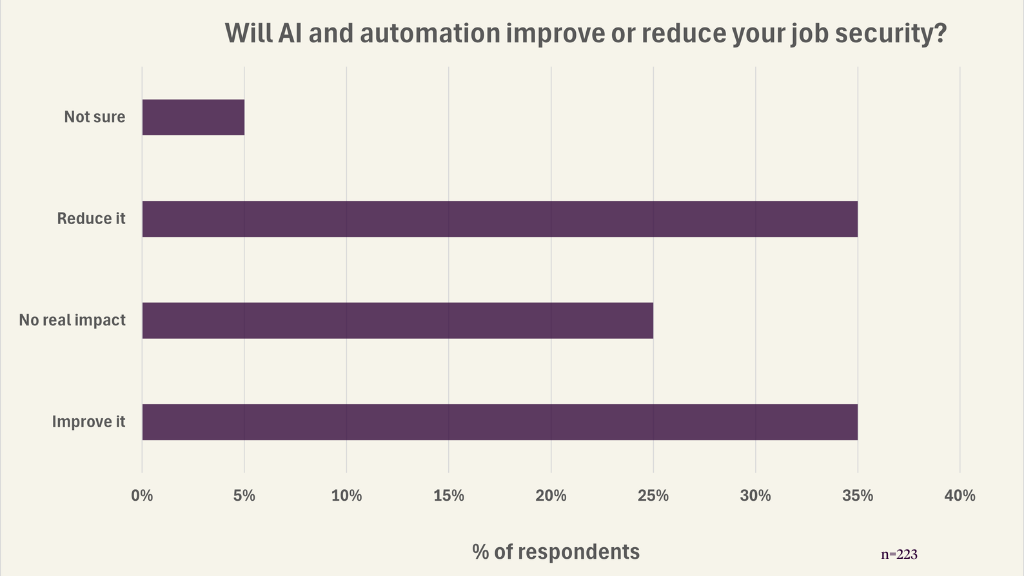
On the surface, the industry appears evenly split. The more telling shift here isn’t the divide. What stands out is the collapse in uncertainty.
In 2023, around 40% of respondents were unsure about AI. In 2026, that number has dropped to just 5%. Mining professionals aren’t asking if AI will impact their work. They’re forming clear views on how it will.
The sentiment beneath the numbers
To understand what’s driving those views, we asked people why they think AI will improve or reduce their job security. Unprompted, this breakdown of mixed views reveals where the concern sits.
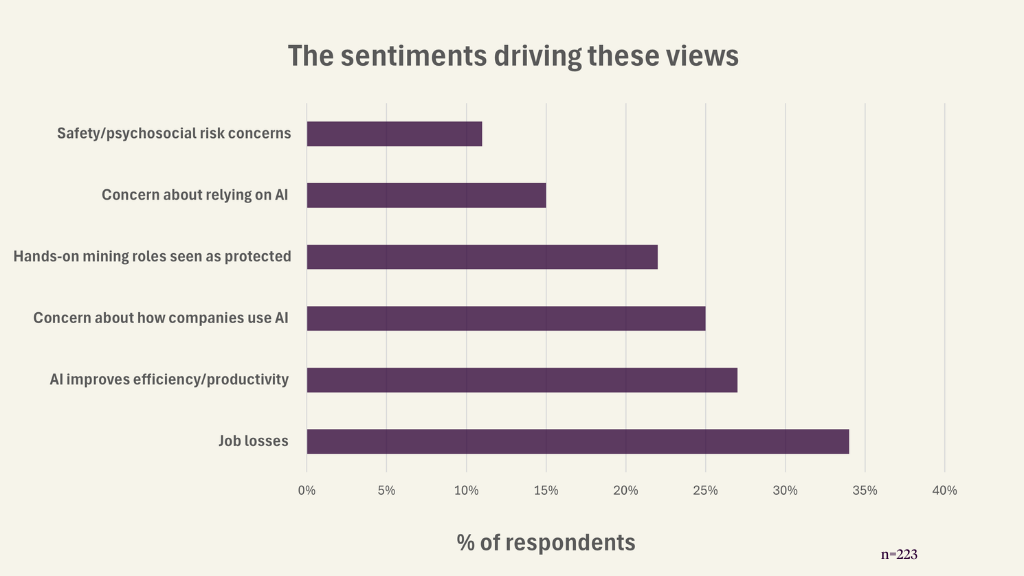
Several consistent themes emerge:
- Many see AI as a useful tool particularly for admin, reporting, and repetitive tasks
- A large portion expect AI to lead to job reduction or smaller teams
- A recurring concern is how AI will be used by companies, particularly around cost and headcount
- Others believe core, site-based roles remain relatively protected due to their complexity and variability
Taken together, these responses highlight a clear, mixed tension.
AI is widely recognised as improving efficiency. At the same time, there’s a strong belief that it will reduce the number of roles required.
“It’s not the technology, it’s how it will be used”
Across the 223 responses, the concern is rarely directed at AI itself. Instead, it’s directed at what happens after it’s introduced.
Respondents repeatedly referenced:
- “Reducing headcount”
- “Cost cutting”
- “Doing more with less”
One respondent noted:
“Of course, it’ll make our jobs easier. Then they’ll realise they don’t need as many people.”
Another said:
“I don’t have an issue with AI. The issue I have is that we’ll be expected to use it, then expected to produce more. The resulting workload could lead to more burnout.”
Others pointed to a loss of control:
“It won’t replace everything, but we’ll be forced to rely on it. Decisions will be made based on systems, not experience.”
These responses suggest the perceived risk isn’t the capability of AI, but how it may be applied in practice.
Confidence on site, caution elsewhere
There remains strong confidence in the resilience of hands-on, site-based roles.
Many respondents pointed to:
- The need for timely decision making
- The variability of on-site conditions
- The importance of experience in safety-critical environments
As one respondent put it:
“AI can’t clean up spills. You still need people on the ground. AI can’t handle everything.”
Another added:
“Being aware of how AI can assist is good. You can still have AI running in the background and focus on mining.”
However, this confidence is not shared across all roles.
Planning, reporting, and administrative functions were more frequently identified as areas where AI has had an impact, which shapes a more uneven picture.
One respondent wrote:
“My partner recently lost her job as an administrator. I worry I may lose mine on the mines one day.”
AI isn’t seen as affecting the mining workforce equally, but reshaping specific parts of it.
The emerging gap between capability and trust
The data points to a broader issue. Many respondents acknowledge AI can improve work. But there’s less confidence in how those improvements will affect jobs.
One respondent replied:
“AI is introduced on the premise of "improved safety, or efficiency" but cost is the main driver. Technology doesn't take holidays or get sick. Some business leaders are not so concerned about job 'quality', just 'more jobs done.’ That’s a safety risk.”
Put simply:
- Productivity gains are expected
- Job security outcomes are uncertain and often viewed negatively
This gap between capability and trust is where much of the current concern sits.
What this means for mining employers
AI adoption in mining is no longer a consideration. It’s already here. But as these results suggest, implementation is only part of the equation.
How it’s communicated and how its impact is managed will shape how it’s received.
There are some practical considerations for employers:
- Be clear on intent and involve people in the process
Be clear on the use of AI. Uncertainty around intent can quickly be interpreted as risk. Introducing new systems top-down can reinforce the perception that change is imposed, not implemented collaboratively.
- Define the role of people alongside technology
People are looking for clarity on where human judgement remains essential. Being specific about its use is more effective than general reassurance.
- Consider long-term workforce pathways
While it’s not a dominant theme, some responses pointed to concerns around reduced entry-level opportunities. This has implications beyond immediate workforce efficiency.
What this means for mining professionals
There are also some practical considerations for mining workers:
- Build familiarity with AI before it’s expected of you
Many of the concerns raised relate to being asked to rely on systems without fully understanding them. Taking the time to explore how AI tools work, even at a basic level, can reduce uncertainty and build confidence.
- Focus on where human judgement adds value
While AI can assist with repetitive and data-driven tasks, respondents consistently pointed to areas where experience, decision-making, and on-site awareness remain critical. Strengthening these aspects will remain important as technology evolves.
- Stay aware of how jobs are changing across the industry
Functions like planning, reporting, and administration are expected to evolve more quickly than others. Keeping an eye on how different roles are shifting can help inform future career decisions, as well as development opportunities.
A shift that goes beyond technology
The comparison between 2023 and 2026 highlights a clear shift.
The conversation has moved from uncertainty to firm views. Mining professionals aren’t waiting to see what happens. They’re forming expectations based on what they’re observing.
And while views on AI remain mixed, one theme is consistent. The concern is not just about what AI can do but what will be done with it.
As AI continues to evolve within the industry, this distinction may prove just as important as the technology itself.
Media note: This article contains original survey data from 223 Australian mining professionals and may be referenced or quoted with attribution.
Media Enquiries
For additional data, worker commentary, or interview requests, please contact:
Mark Pearce, Communications & PR Manager
MPI Recruitment
mark.pearce@mpirecruitment.au
08 9426 1599

Related articles

When Is the Right Time to Hire Someone Smarter Than You?
-
Leadership
-
Executive

Mining’s talent shortage is real, so the response needs to come from organisational leadership.
-
FIFO
-
Leadership
-
Executive
-
Newsroom
When Is the Right Time to Hire Someone Smarter Than You?
- Leadership
- Executive
Mining’s talent shortage is real, so the response needs to come from organisational leadership.
- FIFO
- Leadership
- Executive
- Newsroom