What Mining Talent Wants Isn’t What Employers Think
- Executive
- Newsroom

Mining has historically competed on pay, so why hasn't it fixed the talent shortage problem?
Earlier this year, we surveyed 217 Australian mining professionals to see if they were open to moving jobs in 2026.
A concerning 86% said they were.
When they were asked why, leadership, culture, team, and job satisfaction emerged as their main drivers.
The findings behind the ‘why’ drew some debate. They also raised some important follow-up questions.
Could leadership and culture really outweigh pay in a sector known for high salaries and fierce competition for skills? Or were people simply venting broader frustrations at leadership? Rather than rely on the views of 217 anonymous survey respondents, we decided to test the findings further.
Between 1st and 29th May 2026, we spoke with 1238 blue collar and white collar mining professionals, already open to new opportunities, to find out what would matter most to them when considering a new role.
Importantly, the aim wasn’t only to understand what attracts people, but to also identify the factors that influence whether they remain engaged once they're in a role.
What came back still challenges the long-held assumption in mining: If people leave, just pay them more.
Are attraction and retention primarily a pay problem?
In many organisations, the default response to solving the ‘talent shortage’ problem is throwing more money at it.
There’s some logic to this. Especially in a market where vacancies are high and competition for attracting and keeping skills is intense. But the data suggests something more nuanced is happening.
Across both groups, pay consistently sits in a lower position when people are asked what would make a new opportunity compelling enough to consider.
That doesn’t mean pay is irrelevant, but it’s not the deciding factor many assume it is.
Competitive pay is the entry ticket. It moves people into consideration, however, it rarely tells the full story of why they stay, leave, or choose between employers in a tight labour market.
What's most important to mining professionals?
When we look across the 1,238 conversations, a clearer pattern forms.
While motivations differ between blue collar and white collar roles, both groups point toward a similar set of underlying drivers that can influence attraction and retention decisions.
Let's take a closer look.
Blue collar workforce (756 respondents open to a move)
Their strongest priorities were:
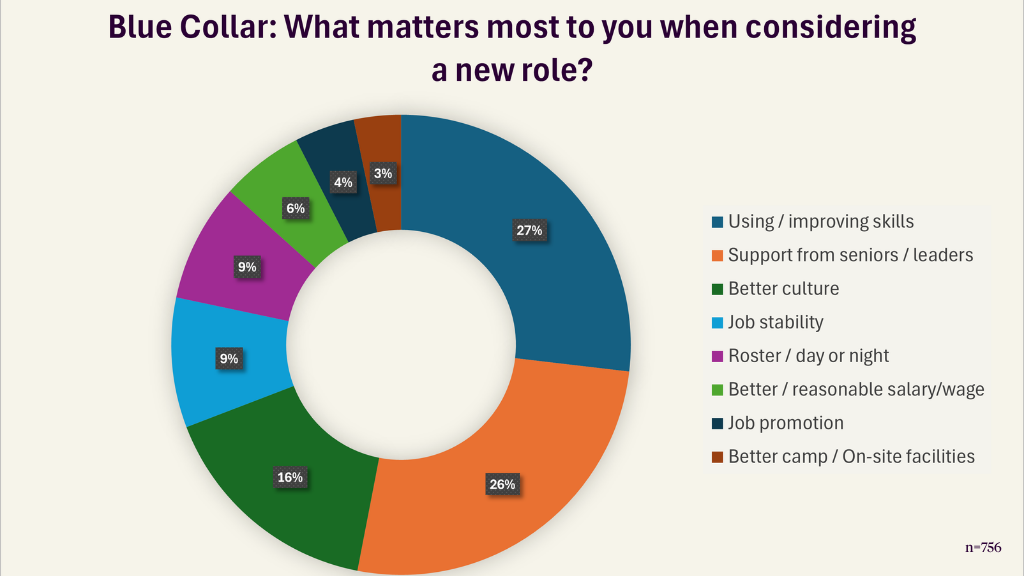
A consistent theme sits beneath these responses. People want to feel useful, supported, and engaged in their work. And rather than just occupied, progressing.
White collar professional & technical (482 respondents open to a move)
Their leading priorities were:
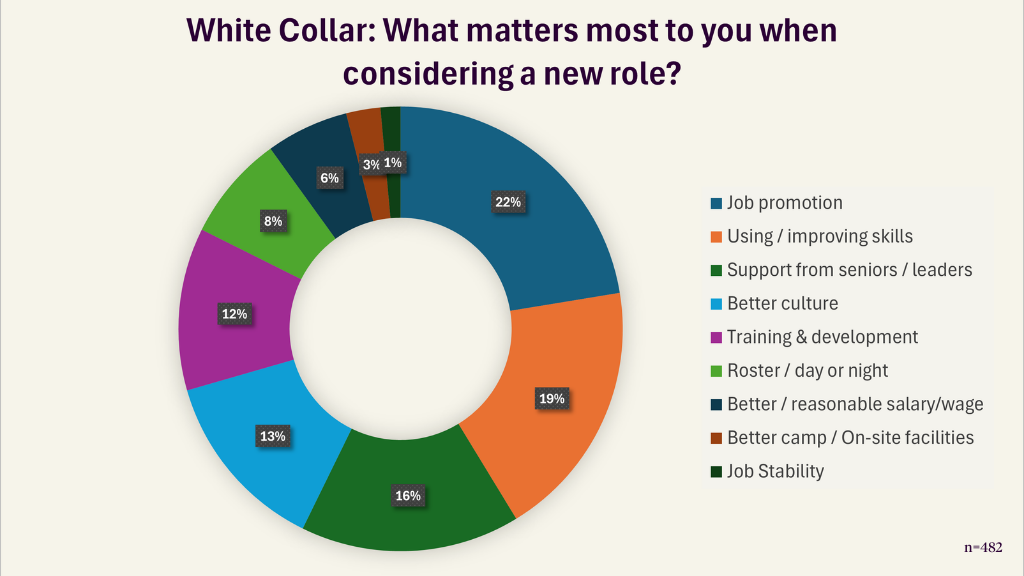
Here, progression becomes more explicit. But the underlying signals are the same. Growth, support, and the quality of leadership matter as much as the role.
When both groups are combined, the themes still reflect how important leadership is.
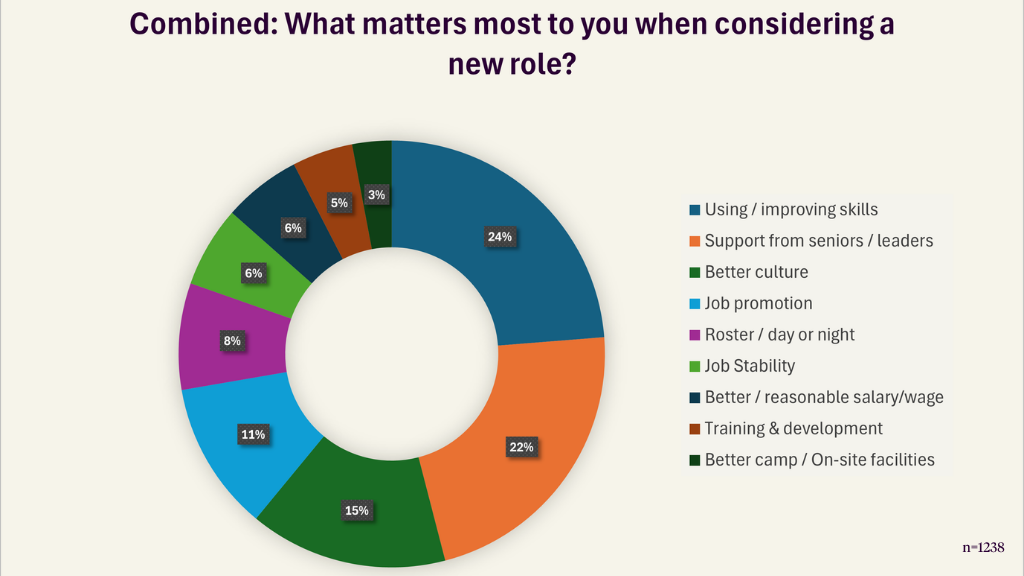
The job motivation themes across both groups
While the order shifts between cohorts, the overlap is hard to ignore. Across both blue and white collar professionals, three themes consistently sit at the centre of decision-making:
- The ability to use and develop skills
- The quality of leadership and day-to-day support
- The broader working culture and environment
Pay and lifestyle factors still matter, but they don’t sit at the top. They’re not a differentiator.
Reframing “leadership” in talent attraction and retention
Our earlier article explored the idea that mining’s retention challenge is not simply about labour shortages, but about leadership and culture shaping whether people stay engaged or start looking elsewhere.
These conversations add another layer to that discussion.
When people talk about “better leadership” in practice, what they’re talking about is what it feels like to work in a team every day.
Comments from respondents included:
- “A decent boss who’s fair, rather than somebody pandering to the cameras to look good.”
- “A @#$$%%^ free zone.”
- “Leadership integrity… values aren’t just words on a wall.”
These sentiments aren’t about more money. They’re expectations around fairness, consistency, and behaviour that matches what’s said.
What people weigh up when considering a move
A useful distinction emerged through both the earlier article and these follow-up conversations.
Trust is transactional. People expect being paid on time, that their manager has their back, and their job is secure enough.
It’s a necessity. It keeps things running.
Belief sits at a higher level. People want to feel that their work matters and it’s valued, that they make a difference, and that they’re building something worthwhile. They also want their leaders to be consistent.
Belief influences whether people invest themselves in their jobs, and their employers.
The problem with mining’s ongoing assumption
The risk for many organisations is that they simplify attraction and retention.
When people are open to moving, it can be tempting to treat the solution as purely financial. But if pay was the dominant factor, we’d expect it to sit consistently at the top of every motivation list.
Instead, the data suggests a broader mix of factors influencing movement:
- Career progression
- Leadership quality
- Support from seniors
- Skill use and development
- Culture and environment
Of course, money matters. But it sits alongside these factors, rather than above them.
What does this mean for employers?
There’s a case here for widening the lens on both attraction and retention. Both are often treated as separate problems.
To employees, they are usually reflections of the same day-to-day experience.
The data suggests that long-term workforce stability is more likely influenced by a combination of the following factors:
Leadership quality
The quality of frontline leadership, especially how consistently leaders communicate, make decisions, support teams under pressure, and behave when things don’t go to plan.
Growth and progression
Whether people can see a pathway forward through skill development, greater responsibility, new challenges, or long-term career progression. They want to avoid feeling stuck in the same cycle.
Support and day-to-day experience
Whether people feel listened to, treated fairly, supported by supervisors, and able to raise issues without being dismissed or ignored.
Engagement in their work
Whether people feel their skills are being properly used, their contribution matters, and the work itself continues to challenge and develop them over time.
Competitive pay is often viewed as a baseline expectation rather than a defining advantage. Once that baseline is met, people begin comparing the quality of leadership, growth opportunities, team culture, and long-term fit.
Final thoughts: You don't need to throw money at hiring
Earlier this year, we explored the idea that leadership and culture are central to mining’s talent shortage challenge.
With 1,238 further conversations across Australia’s mining workforce, that picture has been refined. Attraction and retention are not driven by a single lever.
They sit across a set of everyday experiences. How people are led, how they grow, how they are supported, and whether they can see meaning and a future in what they do.
Mining’s talent shortage is challenging many employers. Yet, as these findings suggest, those organisations that will gain a competitive edge, are the ones that don’t rely solely on offering more money.
Media Enquiries
For additional data, worker commentary, or interview requests, please contact:
Mark Pearce, Communications & PR Manager
MPI Recruitment
mark.pearce@mpirecruitment.au
08 9426 1599

Related articles

Majority of Australian FIFO Workers Say Their Rosters Are Unsustainable
-
FIFO
-
Leadership and Business
-
Newsroom

Have you got your board composition right?
-
Leadership
-
Mining People Matters
-
Executive
Majority of Australian FIFO Workers Say Their Rosters Are Unsustainable
- FIFO
- Leadership and Business
- Newsroom
Have you got your board composition right?
- Leadership
- Mining People Matters
- Executive