Does mining have a talent shortage or an awareness problem?
- Executive
- Free Resources
- Newsroom

Are we looking in the wrong places? Research says we might be.
For as long as any of us can recall, Australia’s mining industry has talked about talent shortages.
Employers have frequently competed on salaries to fill vacancies. Yet, we still return to the ongoing conclusion that we have a shortage of experienced people.
More projects come online. More hiring needs to be done. Yet, the shortage remains. So, why can't we attract and hire enough of the right people?
Maybe, we've been looking at the wrong problem all along. Recent data from MPI Recruitment might just reveal that we have been. If there's one thing this data shows, it's just how little we know about attracting talented people to mining jobs.
We recently asked 482 white-collar mining workers what matters most to them when considering a new job. Their data highlighted 8 different needs ranging from developing skills to job stability.
Then we analysed 482 SEEK and LinkedIn white collar job adverts to see how often these needs were explicitly mentioned. Advertising logic would usually suggest that if these job adverts regularly reflect what’s important to people, then more of those people should apply.
Are we advertising what matters to people?
The data would suggest we're not. It shows that we're talking about what we think will attract people, rather than giving people a convincing reason to consider our jobs.
Here's a snapshot of what matters most to 482 white collar professional and technical people, and what was displayed in 482 white collar jobs (as of October 2026).
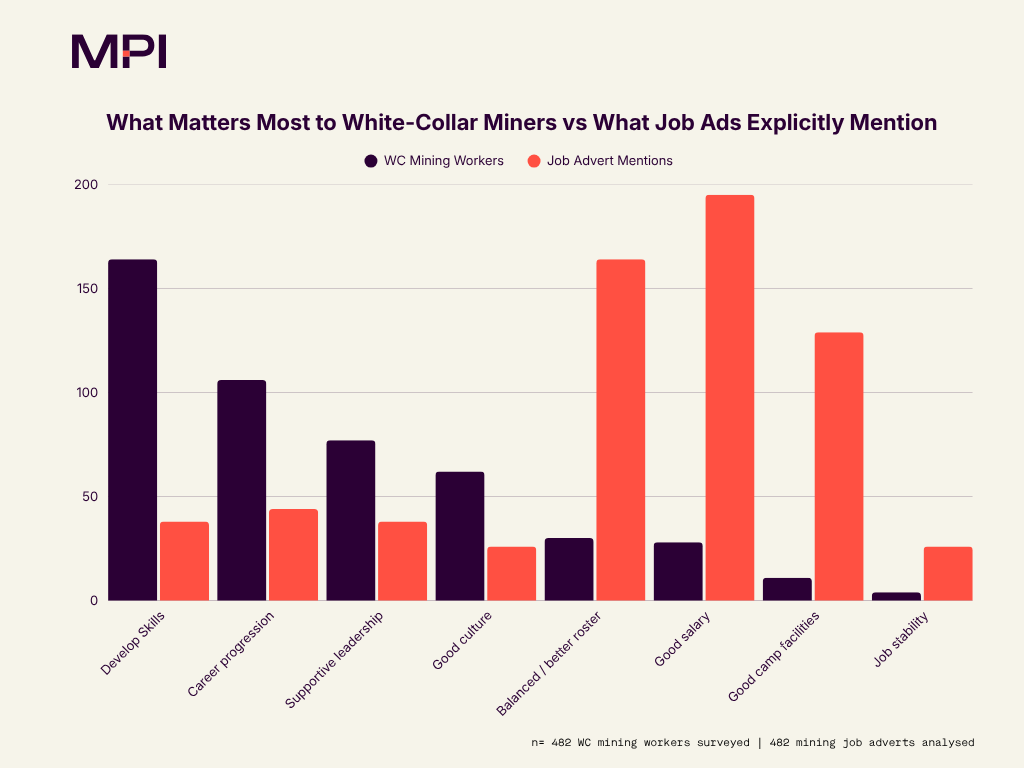
The comparison in the data reveals a disconnect between what workers want most and what employers communicate in their job ads.
For example, salary, rosters and camp facilities feature prominently in job advertising. Yet workers place more importance on opportunities to develop their skills, progress their careers and receive support from senior leaders. Needs that appear less frequently in the adverts MPI analysed.
This doesn't prove employers misunderstand candidates, nor does it tell us why particular benefits are omitted, but it raises an important question.
Are employers giving candidates a clear enough reason to consider their opportunities?
From job descriptions to reasons to apply
Job adverts are often built around a role’s duties and the required experience and qualifications. While some of those details matter, a job description isn't the same as a job advert. A JD doesn’t help somebody picture how they might progress their career. It doesn't highlight how the opportunity benefits the reader.
Employers may offer development opportunities, supportive leadership and clear career pathways without communicating them effectively. Others may be relying on company templates or industry standards rather than evidence of what their target candidates want.
Whatever the reason, there is an opportunity to make recruitment advertising more relevant to the people it needs to reach.
MPI recommends employers take three practical steps.
- Start with candidate priorities. Ask current employees and prospective candidates what would influence their decision to move. The above graph is starting point. Don't assume the factors that matter most to your business are the ones that matter most to candidates.
- Make the duties and benefits specific. Work out the three most important duties somebody needs to perform. Throw away the rest. Listing more only wastes advertising space by reminding experienced people what experienced people do all day. Replace generic promises about career development with concrete examples of the skills people can build, the experience they can gain and the pathways available. Where possible, use specific examples of successful employees to back up your claims. Explain how leaders support their teams and how your culture feels to employees, rather than simply describing everything as supportive or ‘a family’.
- Audit what your advertising says. Review live job ads against the needs of your target audience. Identify which priorities are addressed, which are missing and whether any claims are backed by evidence. Write your adverts for your reader, rather than automatically repeating what you’ve always done, or what other employers say.
Is it time to rethink the talent shortage?
Mining's workforce challenges are complex. Job advertising won't solve all of them but if employers are struggling to attract the right people, examining how they communicate their opportunities is a practical first step.
Before concluding that candidates are in short supply, employers should ask themselves a more uncomfortable question.
Are we giving experienced people enough of the right reasons to choose us?
On this evidence, it seems we're not.
Mark Pearce
PR, Comms & Marketing Manager | MPI Recruitment

Related articles

Mining’s talent shortage is real, so the response needs to come from organisational leadership.
-
FIFO
-
Leadership
-
Executive
-
Newsroom
Mining’s talent shortage is real, so the response needs to come from organisational leadership.
- FIFO
- Leadership
- Executive
- Newsroom
