Majority of Australian FIFO Workers Say Their Rosters Are Unsustainable
- FIFO
- Leadership and Business
- Newsroom

75% not confident their roster is sustainable long-term. New survey raises questions about fatigue and safety on mine sites
At a Glance: The Key Findings
- Only 1 in 4 FIFO workers say their roster is sustainable beyond six months without change
- More than half of FIFO workers say their roster is unsustainable or causing burnout
- 1 in 6 FIFO workers report burnout on current rosters
- People aren’t rejecting FIFO. They’re rejecting long swings. Workers overwhelmingly say the fix is shorter or balanced swings, not higher pay.
Australian FIFO Rosters Aren’t Sustainable
A new survey of Australian FIFO mining workers reveals a troubling reality: More than half say their current roster isn’t sustainable long-term or already causing burnout.
The anonymous poll, conducted between 2nd March and 16th March 2026, gathered responses from 207 FIFO workers across a range of sites and roster types.
To better understand how FIFO workers feel about their rosters, the poll asked three questions:
- What is your current FIFO roster?
- How sustainable do you feel that roster is long-term? (Long term = more than 6 months)
- If you could change one thing to make your roster more sustainable, what would it be?
The results suggest that Australia’s mining challenges aren’t just about labour shortages or pay, but whether current roster designs are manageable for the people doing the work.
What FIFO rosters are people working?
Our first question identified current FIFO roster structures.
The roster data reveals a clear imbalance.
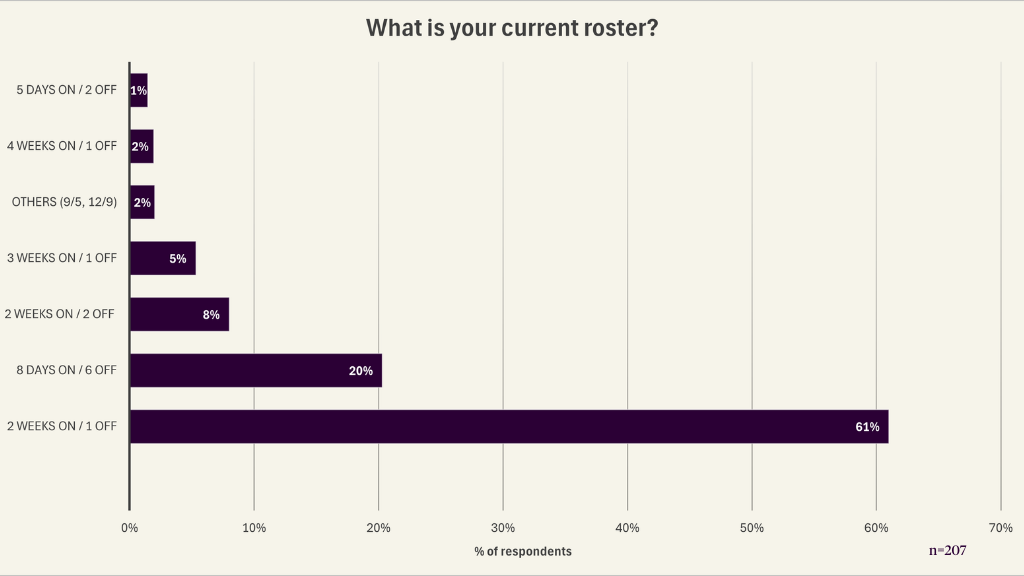
While more balanced formats such as 8:6 and 2:2 are widely considered more sustainable, only 28% of respondents are working these rosters.
In contrast, more than two-thirds (68%) are on longer swings of two weeks or more. The same structures most frequently associated with fatigue, burnout and extended time away from family.
Our second question provides the clearest insight into how workers view their current rosters:
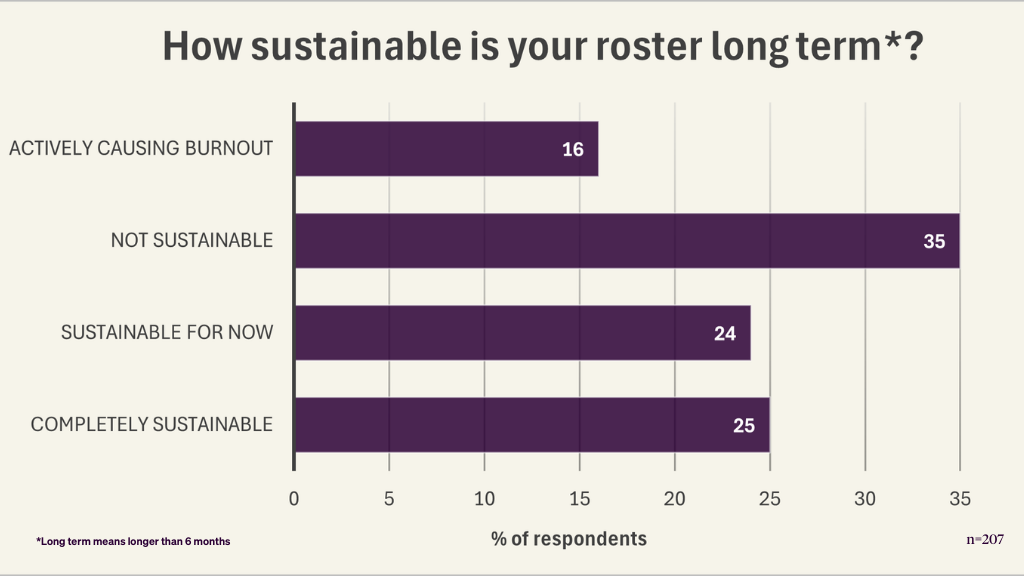
More than half of respondents (51%) say their current roster is unsustainable or already causing burnout.
Even more striking, three-quarters of respondents say their roster is either unsustainable long-term, actively causing burnout, or only manageable for the next six months.
A Warning Sign for a Safety-Critical Industry
Mining is one of Australia’s most safety-critical industries, where fatigue management and alertness are essential to prevent serious incidents. Workers handle heavy machinery, long shifts, and tasks that demand constant focus.
When fatigue builds across extended roster cycles, the consequences can be serious.
Many respondents directly linked unsustainable rosters to exhaustion, a known driver of workplace incidents.
Additionally, psychosocial risks, including fatigue, isolation, high job demands and stigma around mental health, are well documented in FIFO environments, and are often intensified by long swings and limited recovery time.
Several reported feeling physically and mentally drained, especially during long rotations.
One respondent wrote:
“Long swings are the problem. You’re exhausted by the end of it and still have travel home. It’s hard to recover properly before going back again.”
Another confirmed:
“Flight in after 7 AM. Waking up at 3 on fly in day and having to work that 12-hour shift is tough.”
Another added:
“The job itself is fine. It’s the time away and the length of the swing that wears you down. I want to do either 8/6 or 2/2, this roster is burn out.”
While Australia’s mining sector has consistently improved safety standards, fatalities and serious incidents still occur, with fatigue and human factors frequently cited in investigations.
When more than half of workers say their roster is unsustainable or causing burnout, it raises an important question about how effectively that risk is being managed.
The Problem May Not Be FIFO, But How Rosters Are Designed
FIFO work remains an attractive career path for many Australians. But the survey suggests the issue may not be FIFO itself, rather how some rosters are structured.
When asked what single change would make their roster more sustainable, the overwhelming response was clear: Shorter swings and frequent breaks.
Workers repeatedly suggested roster changes, such as:
- Moving from 3:1 to 2:2
- Moving from 2:1 to 8:6
- A balanced 7 days on / 7 days off
- More frequent breaks between rotations
In many cases, the suggested improvements were not radical changes, but rosters already used successfully elsewhere.
One of the most surprising insights from the survey was what workers did not mention.
Despite public discussions about wages in mining, very few respondents suggested pay increases as the key to sustainability.
Instead, workers consistently pointed to:
- More time with family
- Balanced roster swings
- Better organised flight times
In simple terms, workers aren’t asking for higher pay. They’re asking for rosters they can live with long-term.
FIFO May Be Becoming a Short-Term Strategy
The results also suggest a broader shift in how workers view FIFO careers.
While one in four workers say their roster is sustainable long-term, nearly as many say they are only managing it for now.
For many, FIFO appears to be becoming a temporary financial strategy, particularly as rising living costs and inflation pressures drive workers to prioritise short-term income over long-term sustainability.
That trend could have serious implications for the industry, particularly as mining companies continue to face skills shortages and rising competition for experienced workers.
If large numbers of workers are already thinking about their exit timelines, retention may become an increasing challenge.
A Conversation Australia's Mining Industry Can’t Ignore
The mining industry has invested heavily in improving safety and workplace culture in recent years. But the survey suggests roster design may remain one of the most important, and most overlooked factors shaping physical and mental wellbeing, and long-term retention.
At the same time, mental health-related workers’ compensation claims are rising sharply, with industry forecasts pointing to significant increases in both claim volumes and employer costs over the coming years.
For an industry that depends on experienced people operating in complex and high-risk environments, sustainable work patterns are not simply a workforce issue.
They’re a safety issue.
While some roster structures are driven by project demands and can’t be changed, the question then becomes: What support systems are in place around them?
Are companies actively assessing mental resilience before assigning longer swings, checking in regularly with workers on extended rosters, and ensuring those new to mining aren’t placed straight into higher-strain rotations like 2:1 or 3:1 without support?
As this survey indicates, many FIFO workers believe current roster structures may be pushing the limits of what is sustainable.
Leadership Must Bring this Conversation to the Boardroom
In a separate poll conducted recently, many mining professionals cited leadership and workplace culture as key reasons for leaving employers, ahead of pay and perks.
In an industry where fatigue, heavy machinery and long shifts intersect daily, the stakes are clear. If more than half of workers believe their roster is unsustainable or already causing burnout, leaders face a tough but necessary conversation.
Making roster sustainability a boardroom priority, alongside safety, productivity and workforce retention, may be essential to keeping FIFO a viable long-term career option.
Beyond roster design, there are practical steps already being discussed across the industry.
Recent guidance from organisations like Safe Work Australia highlights the importance of fatigue risk management plans that go beyond hours worked, including better shift scheduling, structured rest periods, and ongoing mental health check-ins.
For many workers, feeling heard, supported, and proactively monitored may be just as critical as the roster itself.
Otherwise, how long can any safety system hold if most of the people working inside it are running on empty?
If you know somebody who's been affected by burnout or fatigue, or is struggling with working FIFO, including yourself, the following organisations are a phone call or email away:
Lifeline: 13 11 14, lifeline.org.au
Headspace: 1800 650 890, headspace.org.au
SANE Support line and Forums: 1800 187 263, saneforums.org
Beyond Blue: 1300 224 635, beyondblue.org.au
Media note: This article contains original survey data from 207 Australian mining professionals and may be referenced or quoted with attribution.
Media Enquiries
For additional data, worker commentary, or interview requests, please contact:
Mark Pearce
MPI Recruitment
mark.pearce@mpirecruitment.au
08 9426 1599

Related articles

Why ‘Skills-Based Hiring’ Is Easy to Talk About and Hard to Do
-
Leadership and Business
-
Free Resources

I quit my job and it was my biggest mistake ever...
-
FIFO
-
Lifestyle
-
MPi Life
Why ‘Skills-Based Hiring’ Is Easy to Talk About and Hard to Do
- Leadership and Business
- Free Resources
I quit my job and it was my biggest mistake ever...
- FIFO
- Lifestyle
- MPi Life